 EcoSmart Stud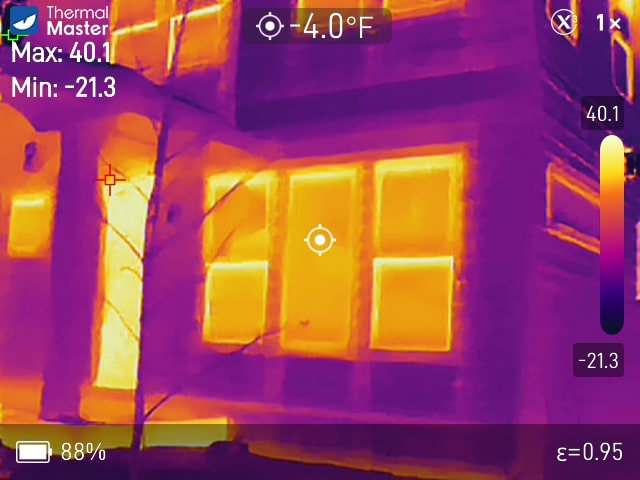
Below Zero Temps = Great Thermal Pictures!
Last weekend, the lows in the Minneapolis, MN area were below zero for about 40 hours. When that happens, it’s time to bring out the thermal camera! It’s the perfect time to see how our 2×6 EcoSmart® Stud wall build in Minneapolis is performing!
-10 Degree Outside Air Temp, Balmy 70 Degree Inside
The actual air temperature when these thermal images were taken was about -10 degrees below zero, and the wind chill was in the -20’s below zero. The home’s inside temperature was set to 70 degrees. About an 80 degree difference inside to outside. This is the perfect real-world test! The temperatures used for the computer Isotherm Comparisons PDF are -0.4 degrees outdoor temperature with a 13.0 mph wind, and an indoor temperature of 69.8 degrees with a 1.0 mph wind. You can download the PDF in our Resource Section.
Another benefit of this Minneapolis build is the tall wall in the stairwell, which uses 2×6 solid studs. Now we have the perfect comparison: 2×6 EcoSmart® Studs and solid 2×6 studs in the same house, under the same harsh weather conditions. Let’s take a look!
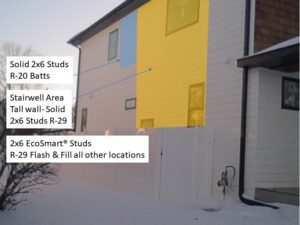
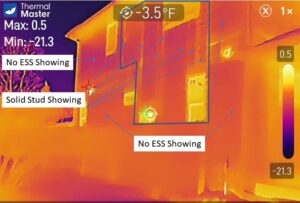
Notice in the solid stud area we see gold studs showing in more of a purple wall area. That is thermal bridging. The studs are considerably warmer than the chamber insulation. Lets take a look at wall area from the inside.
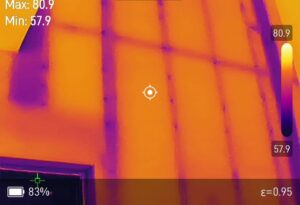
Those solid studs really stand out! On the inside, the studs show as purple because they are cooler than the chamber insulation. The insulation value of the studs with all insulation elements (RSE+ siding+building paper+sheathing+studs+drywall+RSI) adds about another R-2 to the total R-Value. The R-6 stud is now an R-8. The wall chamber is about R-31 (R-29 + R-2), which is about 4 times higher than the studs; the result: thermal bridging. Even the sheet rock screws stand out!
Now for a shot of walls with 2×6 EcoSmart® Studs only.

Most of the wall is the darker purple. The EcoSmart® Studs with all insulation elements included are at about R-15. The chamber is at R-31 and is now only about twice the R-value of the studs. Some of the 3x and 4x wide EcoSmart® Studs assemblies around the windows show as the lighter purple. This is expected because when you have a 4x assembly of EcoSmart® Studs, you get 6 inches of width at R-15 vs R-31. That is far better than 6 inches of R-8 with solid studs. The single studs are not showing up at all. The takeaway from this picture is that minimal thermal bridging is taking place in the wall assembly.
Lets take a look from the inside.
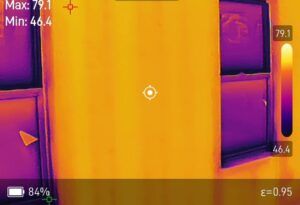
From the inside, we see ghostly images of 2×6 EcoSmart® Studs in the walls, no purple studs here; we do see around the windows, darker shading of multiple studs grouped. These are the areas that showed as lighter purple in the outside pictures. Our thermal images are consistent from the outside of the home to the inside.
Real World Matches Models
This is the first EcoSmart® Stud home where we have been able to get real-world temperatures that match our computer model temperatures and we can break out the thermal imaging camera. Having our computer model of EcoSmart® Studs verified in the field is rewarding. To be able to compare solid stud framing in the same build was a bonus! Let’s take a look.
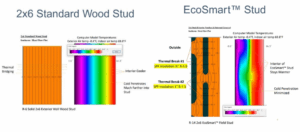
These Isotherm models do not have the extra insulation items for the entire wall assembly, but they show the general premise. The standard 2×6 wood stud; the indoor temp is considerably cooler than the indoor air temp at 69.8 degrees as shown in the computer Isotherm image. The solid 2×6 studs should really stand out in the wall assembly of the Minneapolis home; that is precisely what is seen in the thermal image taken at the Minneapolis home at 70.0 degrees indoor air temp. Purple studs, yellow/orange chamber. The 2×6 EcoSmart® Stud are close to the indoor air temp at 69.8 degrees in the computer Isotherm image. That is what appears in the Minneapolis home thermal image. The EcoSmart® Studs are a ghostly image that is slightly more yellow/orange than the yellow/orange chamber in the thermal pictures at an indoor air temperature of 70.0 degrees. Actual images matches computer model Isotherm predictions.
EcoSmart® Studs, Exterior Continuous Insulation (ECI), Thermal Images Would be Similar
It’s time for a basic comparison here. The framing R-value of the 2×6 EcoSmart® Stud is about R-15, the chamber R-31. For 2×6 with R5ECI wall framing, it’s R-13 for framing, the chamber R-27. Because all these R-values are very similar, we would expect thermal images of a 2×6 ECI wall system to be very similar to those of this 2×6 EcoSmart® Stud build. Both systems improve the home’s energy efficiency by increasing the R-value of the framing and chamber insulation. The difference in the end, is the cost.
Cost is Key, 75-85% Less Expensive for the 2×6 EcoSmart® Stud Wall
That is the key to the EcoSmart® Stud walls, 75-85% less expensive than ECI exterior walls. Saving considerable money on the exterior wall allows money to be shifted to other parts of the thermal envelope. The thermal envelope of a home is a combination of attic, wall, window, and foundation insulation. It’s essential to have all of these insulation elements in the right balance for thermal and moisture control. The Energy Star Net Zero Ready Home program gives us all the needed information to build a super energy efficient home for the different climate zones around the country. We went through a climate zone 6 build in this previous Build Series post.
While it was a painfully cold morning to be out with a thermal camera, the information gained was well worth it!