 EcoSmart Stud
In the last 2 articles, we have gone through the potential financial savings for our Net Zero Ready and Net Zero case study home: a missing-middle rambler style new home. Let’s take a look at those numbers again.
The Net Zero Ready Case Study Home Energy Savings
The estimated energy cost savings are:
- At 10 years, $19, 339.24
- At 20 years, $56,649.24
- At 30 years, $128,246.28
The Net Zero Case Study Home Energy Savings
The estimated energy cost savings are:
- At 10 years, $34,066.56
- At 20 years, $99,530.76
- At 30 years, $225,433.56
We used a 50-year historical average of 6.75% yearly increases in energy prices for natural gas and electricity. Actual future costs could vary due to factors like rising electricity demand from AI data centers or other energy industry price shocks. This means your savings could be even higher or a bit lower depending on these variables. Currently we are seeing energy price increases of 10-20% per year well above the 50 year average due to mainly to the build out of AI data centers.
How the Years Can Add Up Even More
First of all, this is not investing advice! We are just examining the next step: if you save “X” amount of money per year, what would it be after 10, 20, and 30 years? We add the fact that energy over a 50-year average gets 6.75% more expensive each year. We add that information to our example. The final addition to the example: what if those savings were invested, looking at historical returns for those investment vehicles.
If you consider investing your energy savings in options like stocks, bonds, or ETFs-such as the S&P 500, which has averaged about 9.6% annual returns-you could potentially grow your savings over time. Let’s explore some common investment vehicles and their historical returns for the Net Zero Home savings, helping you understand how your energy savings could expand through investments.
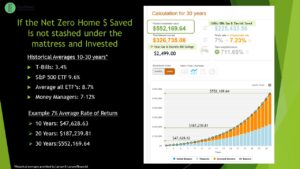
We picked a 7% rate of return, which is below the all-ETF average of 9.6% and the low end of a professional money manager’s range. It’s higher than T-bills, which are considered the safest investment, but far under the highest average return. We focused on the Net Zero Home figures in the graph. It turns out that the Net Zero Ready Homes savings figures, if invested at a 7% return, are very close to the Net Zero Home savings totals. Take a look at the energy savings figures for our Net Zero Ready case study home, and the Net Zero case study homes’ savings figures become the invested side of the equation.
What the Investment Industry Thinks of Energy Efficient Homes
Here is an excerpt from the article “Smart Money Plays: Why Energy-Efficient Homes are the Future of Sustainable Wealth.” The opening paragraph highlights the importance of energy-efficient homes for investors and homeowners, stating:” The global energy market is at a crossroads. As prices for fossil fuels remain volatile and climate policies tighten, homeowners and investors are seeking ways to insulate themselves from financial risks.” It continues, “Energy efficient homes, once seen as a niche sustainability play, are now emerging as a strategic assets class,” underscoring their growing role in financial planning. It concludes with “proven cost savings, and resilience to energy price swings, these upgrades offer a rare win-win: long-term financial stability and reduced carbon footprints.”
Recognized by the investment industry as a “strategic asset class, “energy-efficient homes demonstrate their importance for investors and homeowners. Building a home that insulates (no pun intended) you from increasingly volatile energy costs can free up extra funds to invest in other financial resilience strategies, supporting your family’s long-term wealth and stability.
Up next, personal energy independence.