 EcoSmart Stud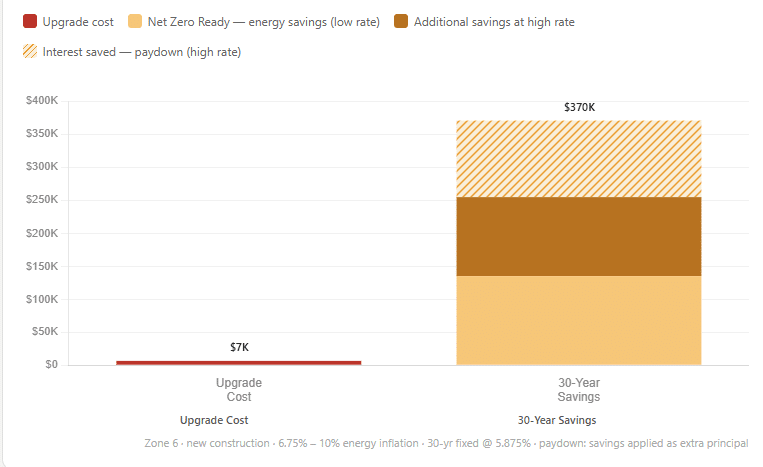
Back in our Build Series, we walked through what it would actually cost to build Blue Barn Construction’s 1,420 sq ft rambler here in Minnesota to the Energy Star Zero Energy Ready Home performance level using the EcoSmart® Stud wall system. Review the article here. The upgrade over current Minnesota energy code came out to $4,485 in construction costs, plus roughly $2,000 for energy rating and inspection — about $6,485 total. At the time, that felt like a reasonable number on paper. But what does $6,485 actually buy a homeowner over the life of a 30-year mortgage?
Now that the Total Cost of Ownership Calculator is live on the EcoSmart® Stud website, we can finally answer that question with real numbers instead of estimates. So we went back to the Blue Barn case study, plugged in the $6,485 upgrade cost, and ran it through 30 years of energy pricing scenarios. The results were bigger than we expected.
Setting Up the Comparison
The Total Cost of Ownership Calculator models energy savings across two rate-increase scenarios. A 6.75% annual energy increase (low) and a 10% annual energy increase (high) and applies those savings against a 30-year mortgage. For this run, we used a 5.875% mortgage interest rate which lets the calculator show not just the energy savings themselves, but what happens if those savings are applied directly to mortgage principal paydown.
In other words, this isn’t just “how much will I save on my energy bill.” It’s “what does that savings do to my mortgage if I put it to work?”
The Numbers Over 30 Years
Starting with a $6,485 upgrade cost, here’s what the calculator showed for the Blue Barn rambler over a 30-year mortgage:
Low-rate energy savings (6.75% annual increase): $135,884
Additional high-rate savings (10% annual increase): $119,138
Potential mortgage interest savings: $114,745
Total potential savings: $370,767
That last number is the one that stands out. A $6,485 upfront investment in a more efficient new home, a little over 1% of this home’s total build cost turning into a potential $370,767 in combined energy and mortgage interest savings over three decades.
Paid Off in Year Four – With a Bonus
Here’s the part that really changes the conversation: the calculator shows the $6,485 upgrade cost paid back by year four. After that, every dollar saved on energy is pure upside.
And there’s another wrinkle worth pointing out. Even when you factor in financing that $6,485 into the mortgage meaning the homeowner is paying interest on that extra amount, the model still comes out about $79 positive per month in lower energy bills compared to not making the upgrade at all. The upgrade doesn’t just pay for itself eventually; it’s cash-flow positive almost immediately, even with financing costs included.
One more detail the calculator surfaced: applying the energy savings to mortgage principal can shave roughly seven years off a standard 30-year mortgage, bringing it down to about 23 years. That’s not a hypothetical incentive or rebate-driven number – that’s just what happens when a home uses meaningfully less energy, year after year, and that savings gets put to work.
What This Means for Your Build
We’ve used the Energy Star Zero Energy Ready Home performance level as our benchmark throughout the Build Series because it represents a clear, well-documented standard for how efficient a home’s envelope and mechanical systems can be. It’s a useful reference point for understanding where a build stands – not a certification requirement, and not something tied to specific rebate programs.
What the Blue Barn case study numbers really demonstrate is the relationship between upfront energy efficiency costs and long-term ownership costs. The wall assembly is one of the few parts of a home thermal envelope that’s essentially permanent, you don’t get a do-over on insulation values after drywall goes up. Getting that decision right at the framing stage, when the EcoSmart® Stud wall system makes the total upgrade cost difference relatively small, has outsized effects on what a homeowner pays for decades afterward.
It’s Your Money – Where Does It Go?
When you look at these numbers, it really comes down to one question: is it worth $6,485 in upgrade costs to potentially save $370,767 over 30 years? You be the judge.
That money is going somewhere either way. Every month, a check goes out to the energy company to heat and cool the home. With a less efficient wall system, more of that check is paying for energy that’s leaking out through the walls — money that’s gone for good. With the EcoSmart® Stud upgrade, that same money stays in your pocket instead, whether that’s lower monthly bills or a mortgage that gets paid off about seven years early.
Do you want to pay it to the energy company, or keep it for yourself? For a little over 1% of this home’s total build cost, the Blue Barn case study shows what it looks like when you get to keep it.
Run the numbers for yourself. See how the differences play out for your climate zone, home size, mortgage rate, and down payment. Be an informed new home buyer.
See what the numbers look like for your own build. Head to our Calculators page and run the Total Cost of Ownership Calculator with your home’s size, climate zone, and financing details to see your own 30-year picture.